
If LASIK isn't recommended for your high nearsightedness, an implantable lens such as EVO ICL is a strong option to explore, along with PRK and refractive lens exchange. According to its FDA-labeled indication, EVO ICL is for adults ages 21 to 60 with nearsightedness from -3.0 to -20.0 diopters, a stable prescription, and enough space inside the eye for the lens. Only an exam can confirm what fits your eyes, so talk with a qualified eye surgeon about your options.
Why Might LASIK Not Be Right for High Nearsightedness?
LASIK may not be right for high nearsightedness when your cornea is too thin to be reshaped safely. LASIK works by reshaping the cornea, and the FDA notes that performing a refractive procedure on a cornea that is too thin may result in blinding complications. A "no" to LASIK just means a different procedure may fit your eyes better.
Eye doctors measure nearsightedness in diopters (D), a unit that shows how strong your lens prescription is. High nearsightedness means a prescription of -6.00 D or stronger. You are far from alone: the National Eye Institute reports that about 41.6% of Americans are nearsighted, up from 25% in 1971.
A thin cornea is a measurement, not a verdict. It simply points your surgeon toward options that work differently.
What Is the Best Option for High Nearsightedness When LASIK Isn't Recommended?
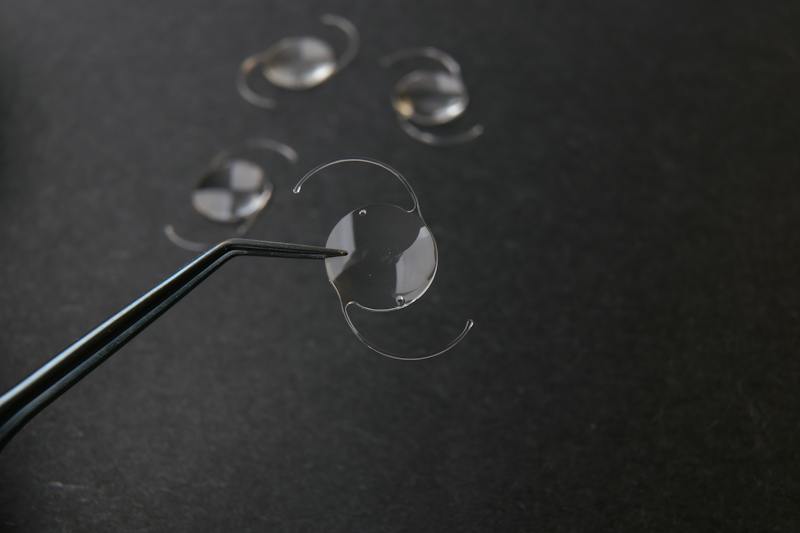
For many people with high nearsightedness, EVO ICL is a strong option when LASIK isn't recommended. The EVO Implantable Collamer Lens is placed inside the eye, behind the iris and in front of your natural lens, so no corneal tissue is removed. The FDA-labeled range reaches -20.0 diopters, well beyond the high-myopia threshold of -6.00.
At EVO ICL at Eye Surgeons of Indiana, this small, biocompatible lens is made from Collamer, a collagen-containing material. It adds a lens to your eye instead of reshaping the cornea. It also leaves your natural lens in place, according to the FDA. That design is why EVO ICL is often considered by people who have been told LASIK isn't suitable for them.
Who Is a Good Candidate for EVO ICL?
A good EVO ICL candidate is typically an adult ages 21 to 60 with nearsightedness between -3.0 and -20.0 diopters, a prescription that has stayed stable, and enough space between the cornea and natural lens. Your surgeon confirms these details with measurements during a consultation, so you know whether EVO ICL fits your eyes.
Based on the FDA-labeled indication, candidates generally have:
- An anterior chamber depth of 3.00 mm or more. This is the space between the inner cornea and the front of your natural lens.
- A stable prescription. Your prescription should stay within 0.5 D for one year before surgery.
- Nearsightedness, with or without astigmatism. For myopic astigmatism, the label covers 1.0 to 4.0 D of cylinder.
EVO ICL is not for everyone. Your surgeon may advise against it if the shape of your eye is not appropriate, you do not meet the minimum endothelial cell density for your age (a measure of the cells lining the inside of the cornea), you have moderate to severe glaucoma, or your vision is not stable. It is also not recommended if you are pregnant or nursing.
What Can You Expect From EVO ICL Vision and Recovery?
EVO ICL is designed to improve distance vision, and FDA study results are encouraging. Among 327 patients followed for six months, 75.9% of implanted eyes (432 of 569) reached 20/20 vision or better and 98.9% (563 of 569) reached 20/32 or better. Individual results vary.
Longer-term data are also reassuring. In a 3-year FDA trial of 629 eyes, the manufacturer reported no cases of pupillary block or pigment dispersion and a 0.16% rate of anterior subcapsular cataract, a type of lens clouding.
Visual quality matters too. A meta-analysis of 1,036 eyes found ICL and SMILE (a laser procedure) had similar efficacy and predictability for high myopia, while ICL had a better safety index and better visual quality measures. A separate network meta-analysis found ICL produced lower higher-order aberrations, which are subtle focusing imperfections that can affect visual quality, than LASIK, PRK, SMILE, and other procedures.
Here is what to keep in mind:
- EVO ICL corrects distance vision. You may still need reading glasses as you age.
- Your surgeon can remove or replace the lens if medically needed, according to Eye Surgeons of Indiana.
- After surgery, our team schedules follow-up visits to monitor the lens and your eye health, as described on the EVO ICL results page.
- As with any eye surgery, risks may include inflammation, increased eye pressure, cataract, or the need for another procedure. Your surgeon will review them with you.
How Do PRK and Refractive Lens Exchange Compare for High Nearsightedness?
PRK and refractive lens exchange (RLE) are two other options your surgeon may discuss when LASIK isn't recommended. PRK reshapes the cornea without creating a flap, while RLE replaces the eye's natural lens with an artificial lens. Eye Surgeons of Indiana reviews all of these options with you so the procedure matches your eyes and goals.
PRK is a laser procedure that applies the laser directly to the corneal surface. Recovery is slightly longer than LASIK. RLE can be a fit for patients who are not candidates for corneal-based procedures, especially those approaching presbyopia, the age-related need for reading glasses.
Our team's EVO ICL alternatives guide explains that EVO ICL is often ideal for higher prescriptions, while LASIK or PRK may suit mild to moderate corrections. Each option has a place. Your measurements point to the right one.
What Is the Next Step If You've Been Told No to LASIK?
The next step is a comprehensive consultation, where your surgeon measures your eyes and explains which option fits. You do not need to decide in advance. Eye Surgeons of Indiana offers EVO ICL at locations including Indianapolis, Muncie, Greenwood, Greenfield, Kokomo, and Anderson.
Being told LASIK isn't right for your high nearsightedness doesn't have to end your search for clearer vision. EVO ICL, PRK, and lens exchange each offer a path, and the right one depends on your eyes. Talk with a qualified eye surgeon about your options, and schedule an EVO ICL consultation at Eye Surgeons of Indiana to find out which fits you.
Frequently Asked Questions
Can I get EVO ICL if my prescription is too strong for LASIK?
Possibly, since the FDA-labeled range for EVO ICL is -3.0 to -20.0 diopters. Eligibility also depends on your eye's anatomy, including the space behind the cornea, and a stable prescription over the past year. A consultation with measurements is the only way to confirm whether EVO ICL fits your eyes.
What is the age range for EVO ICL?
The current US indication for EVO ICL is ages 21 to 60. It was previously approved for ages 21 to 45 before the FDA expanded the range in 2026. Within that range, your surgeon still evaluates your eye health, prescription stability, and anatomy before recommending the procedure.
Will I still need reading glasses after EVO ICL?
You may need reading glasses as you age, because EVO ICL corrects distance vision and does not prevent age-related near-vision changes. Your surgeon can talk through what to expect at your age and how your near-vision needs fit your goals.
Is EVO ICL removable?
Eye Surgeons of Indiana describes EVO ICL as a lens your surgeon can remove or replace if medically needed. That flexibility is part of what distinguishes it from procedures that reshape the cornea. Your surgeon can explain when removal or exchange might be considered.
How do I know whether PRK, EVO ICL, or lens exchange fits my eyes?
A comprehensive exam is how you find out, because the right choice depends on corneal thickness, prescription strength, eye anatomy, and age. Eye Surgeons of Indiana's team reviews your measurements and goals and walks you through each option, so you can choose a procedure with confidence.
Is EVO ICL better than LASIK for high nearsightedness?
For high nearsightedness, a network meta-analysis found ICL produced lower higher-order aberrations than LASIK, PRK, SMILE, and other procedures, which may matter for visual quality. Which is better depends on your corneal thickness, prescription, and anatomy, so an exam decides which option fits.